
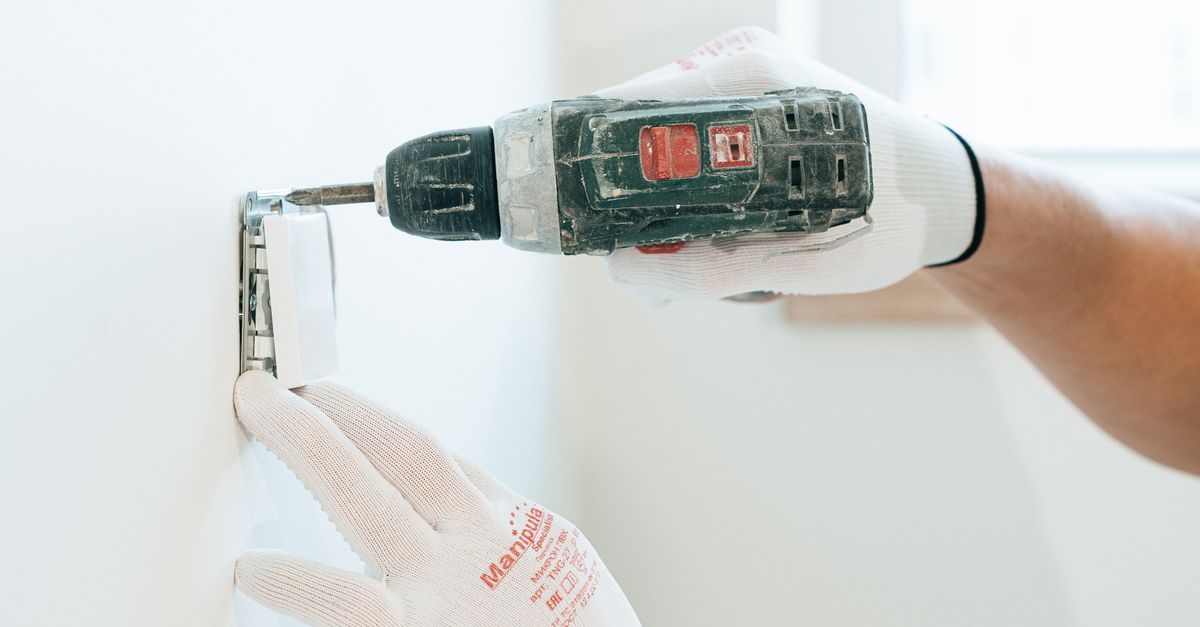
Wall sconces add functional lighting to hallways, bedrooms, and bathrooms—and if you’re tapping power from an existing circuit, installing one yourself is realistic. I’ve installed sconces in three rental properties over the years. One went smoothly, one required a redo because I miscalculated the circuit load, and one taught me that surface-mounted conduit exists and isn’t as ugly as it sounds.
The work crosses into electrical territory, which means you need the power off, the right connections made correctly, and honest judgment about when to stop. This guide covers not just the installation steps, but the load math that prevents overloaded circuits and the wiring details that keep your house from catching fire.
What you’ll need
Tools:
- Non-contact voltage detector (critical—this confirms power is off)
- Screwdrivers (Phillips and flathead)
- Wire strippers
- Drill/driver
- Stud finder (optional but helpful)
- Flashlight or headlamp
- Drywall saw (only if opening a new wall cavity)
Materials:
- Wall sconce fixture with mounting bracket
- Electrical wire (14-gauge or 12-gauge, matching your circuit)
- Wire nuts (typically included with fixture)
- Drywall anchors or toggle bolts (if not mounting into studs)
- Electrical tape
- Bulb (per fixture specifications)
Prerequisites:
- Comfort working with the power off at the breaker
- Access to an existing outlet, switch, or junction box to tap power
- Confirmation that your local code allows homeowner electrical work without a permit (call your building department)
Before you start
Wall sconce installation sits at moderate risk. You can DIY this if you’re tapping an existing circuit, you’re comfortable verifying power is off, and your jurisdiction doesn’t require licensed electrical work for fixture installation. But there are clear boundaries.
Call a professional if:
- You need to run new electrical cable through walls or ceilings (hidden rough-in work typically requires a permit and inspection)
- You’re unsure whether your circuit has capacity for another fixture
- Your sconce requires GFCI protection and you’re not familiar with GFCI wiring
- You encounter aluminum wiring (common in homes built before 1972—requires special connection techniques)
- The existing outlet or switch is hot and you can’t isolate power at the breaker
- Local code mandates licensed electrician work (some jurisdictions do; verify before buying parts)
Pro cost for fixture installation runs $150-$300 including labor, parts, and code compliance. If safety is the question, it’s worth the cost.
Code and permit considerations: Most jurisdictions treat fixture replacement or addition to an existing circuit as homeowner-permitted work, but enforcement varies. Call your local building department and ask: “Does installing a hardwired wall sconce require a permit?” Get the answer before you start.
If your sconce is going in a bathroom within 6 feet of a tub or shower, the fixture must be rated for damp or wet locations, and the circuit must have GFCI protection per the National Electrical Code. Check the fixture label and your outlet/switch—if there’s no “Test” and “Reset” button on the outlet, you’ll need to add GFCI protection or hire an electrician.
Safety first: Turn off power at the breaker, not just the switch. Label the breaker so no one flips it back on while you’re working. Use a non-contact voltage detector to confirm the wires are dead before touching anything. According to the Electrical Safety Foundation International, electrical fires account for an estimated 51,000 home fires annually—most caused by faulty wiring or overloaded circuits. This is non-negotiable.
Calculate your circuit load before adding a fixture
The existing article mentions checking circuit load but doesn’t explain how. Here’s the math that prevents tripped breakers and fire risk:
-
Find your breaker amperage. Open your breaker panel and read the number printed on the breaker switch controlling your target circuit—typically 15A or 20A for general-use circuits.
-
Calculate wattage capacity. Multiply the amperage by 120 volts:
- 15A circuit: 15 × 120 = 1,800 watts maximum
- 20A circuit: 20 × 120 = 2,400 watts maximum
-
Subtract existing loads. Walk the circuit and note every device: lights, outlets in use, permanently connected appliances. Add up their wattages (check labels or use a kill-a-watt meter). Subtract this from your capacity.
-
Apply the safety multiplier. The National Electrical Code requires continuous loads stay below 80% of circuit capacity. Multiply your sconce wattage by 1.25 to account for this. If (existing load + sconce wattage × 1.25) exceeds your capacity, don’t add the fixture to this circuit.
Example: You have a 15A circuit (1,800W capacity) with two table lamps (60W each) and a TV (120W) already on it. That’s 240W in use. Your sconce uses a 60W-equivalent LED (actual draw: 9W). 9W × 1.25 = 11.25W. Total: 240 + 11.25 = 251.25W. You’re safely under 1,800W.
Most LED sconces draw 6-15 watts, so capacity is rarely the limiting factor anymore—but it’s worth checking before you drill holes.
Step 1: Turn off power and verify it’s off
Locate the breaker that controls the outlet or switch you’re tapping. Flip it off, then test the outlet with a lamp or phone charger—no power means you found the right breaker.
Now use your non-contact voltage detector. Hold it near the outlet terminals and inside the box. The detector should stay silent. If it beeps or lights up, you’ve got the wrong breaker. Find the right one before proceeding.
I keep a cheap breaker lockout tag on hand to label which breaker I’ve turned off—prevents someone from helpfully “fixing” the power while I’m wrist-deep in a wall box.
Step 2: Choose your power source
You have three options for powering the sconce:
Option A: Tap an existing outlet (easiest, no switch control). The sconce will be on whenever the outlet is live. Works well for hallway accent lighting.
Option B: Wire through an existing light switch (moderate complexity, gives you on/off control). Requires opening the switch box and connecting the sconce to the switch’s load side.
Option C: Run new wire to a new switch location (most complex, often requires a permit). Unless you’ve done electrical rough-in before, this is pro territory.
For a first sconce install, I’d start with Option A or B using an accessible switch.
Step 3: Plan your mounting location
Hold the sconce’s mounting bracket against the wall at your intended height—typically 60-66 inches from the floor for bedside sconces, 66-72 inches for hallway lighting. Mark the screw holes with a pencil.
Use your stud finder to check if the holes align with a stud. If yes, you can drill directly into the stud. If not, you’ll need drywall anchors rated for the fixture weight (most sconces weigh 3-8 pounds; use toggle bolts rated for 50+ pounds to be safe).
Tap the wall gently with your knuckle. A hollow sound is clear; a solid thud means you’ve found a stud or obstacle. If you hear what sounds like water pipes or HVAC ducts, shift your location a few inches.
Step 4: Prepare the junction box and wiring
Turn off the power (you already did this, right?). Remove the outlet or switch cover plate, unscrew the device, and pull it partway out of the box.
You’ll see three wires (or wire groups):
- Hot (black or red): supplies power
- Neutral (white): completes the circuit
- Ground (bare copper or green): safety ground
Identify which wire is which. If you’re tapping an outlet, the hot wire connects to the brass-colored terminal, neutral to the silver terminal, and ground to the green screw.
Measure the distance from this box to your sconce location. You’ll run electrical cable (Romex or NM-B rated for your area) along this route.
Step 5: Run wire to the sconce location
If you’re running cable through an open wall cavity (behind drywall, above drop ceilings), use approved NM-B cable matching your circuit gauge—14-gauge for 15-amp circuits, 12-gauge for 20-amp.
Keep the wire route along studs or ceiling joists. Avoid sharp bends. Leave 6-8 inches of slack at both ends for connections—stretched-tight wire is a recipe for loose connections later.
The surface-mounted conduit option
Most guides present a false binary: tap an existing circuit with minimal visible wiring, or run new cable hidden in walls (permits, professional installation, drywall repair). There’s a middle ground that gets overlooked: surface-mounted conduit.
Surface-mounted conduit—plastic or metal raceways that run along your wall surface—lets you route new power without cutting into walls. In many jurisdictions, surface conduit work falls outside permit requirements when installed per the National Electrical Code and manufacturer specs, though you should verify with your local authority having jurisdiction (AHJ) before proceeding.
This approach makes sense when:
- Your sconce location is more than 6 feet from any existing outlet or switch
- You want switch control but don’t have a convenient switch box to tap
- You’re installing multiple sconces and need a clean power run
- You’re in a rental and want a reversible installation
The conduit comes in paintable white or can be mounted along baseboards and door trim where it’s less visible. I used this method in a rental hallway where the previous owner had inexplicably removed all the ceiling boxes—the conduit runs along the crown molding and is nearly invisible from standing height.
If you’re running wire along a baseboard or visible surface without conduit, use conduit or raceway to protect the cable from damage. This is code in many areas and also prevents someone from puncturing the insulation with a furniture leg.
At the sconce location, drill your mounting holes and install anchors if needed.
Step 6: Connect the sconce wiring
Most pre-assembled sconces have a three-wire pigtail: black (hot), white (neutral), bare copper (ground). Follow the manufacturer’s wiring diagram—it’s usually printed inside the fixture canopy or included in the instructions.
If tapping an outlet (sconce always on):
- Strip 1/2 inch of insulation from each wire end
- Twist the sconce’s black wire together with the outlet’s hot (black) wire
- Secure with a wire nut, twisting clockwise until tight
- Repeat for neutral (white to white) and ground (bare copper to bare copper)
- Tug each connection gently—if the wire pulls out of the nut, redo it
If wiring through a switch (sconce controlled by switch):
This is where most DIY guides get vague. Here are the actual terminal connections for a standard single-pole switch controlling your sconce:
-
At the switch box, identify your terminals:
- The switch has two brass or black screw terminals (line and load)
- The line terminal receives power from the breaker (the always-hot wire)
- The load terminal sends switched power to the fixture
-
Connect the sconce hot wire (black):
- If the switch already controls another light, you’ll splice the sconce’s black wire into the existing load wire using a wire nut. This puts both fixtures on the same switch.
- If this is a new switch installation, connect the sconce’s black wire directly to the load terminal (often marked “load” or located opposite the incoming line wire).
-
Connect neutral (white):
- The sconce’s white wire connects to the neutral bundle in the switch box—typically several white wires twisted together under a wire nut. Remove the existing nut, add your sconce neutral to the bundle, twist all wires together clockwise, and secure with a new appropriately-sized wire nut.
-
Connect ground (bare copper or green):
- Add the sconce’s ground wire to the ground bundle in the box (usually bare copper wires twisted together, sometimes including a pigtail to the switch’s ground screw). Use the same wire-nut method as neutral.
-
Verify no exposed copper:
- After making connections, ensure no bare wire extends beyond the wire nut. If you see exposed copper, remove the nut, trim the wire, and reconnect. Exposed wire contacting the metal box causes shorts and tripped breakers.
The OSHA electrical safety standards emphasize proper wire connections as a primary fire prevention measure—loose or exposed connections create resistance, heat buildup, and arc faults.
Wall sconce wiring gets tricky when you’re integrating with an existing switch, especially three-way switches. If you’re not confident identifying line vs. load terminals, take a photo of the existing wiring before disconnecting anything, or consult detailed switch wiring guides before proceeding.
Step 7: Mount the bracket and fixture
Install the mounting bracket using your pre-drilled holes. If screwing into a stud, drive wood screws snug but don’t overtighten—stripped screw holes in drywall don’t get a second chance. If using anchors, follow the manufacturer’s torque specs.
Tuck the wired connections back into the wall box (or junction box, if you’ve installed one). Sconces with deeper canopies give you more room for this—shallow modern fixtures can be tight.
Slide or screw the sconce body onto the bracket per the instructions. Most sconces either hang on a center post or clip onto side brackets.
Step 8: Restore power and test

Push the outlet or switch back into its box and screw it down. Install the cover plate. Go back to the breaker panel and flip the breaker on.
Test the sconce. If you wired it to a switch, flip the switch on and off. If you tapped an outlet, the sconce should light immediately.
No light? Turn the breaker back off, pull the fixture, and check your wire nut connections. Make sure the wire ends are fully inserted and the nut is tight. Also verify the bulb is seated correctly and not a dud.
Step 9: Install the bulb and finish
Once the sconce lights up, install the correct bulb type and wattage per the fixture label. LED bulbs work in most modern fixtures and draw far less power than incandescent—I’ve standardized on LEDs across all my rental units because they last years and tenants don’t call about burned-out bulbs.
Attach the shade, diffuser, or trim ring if your fixture has one. Step back and check the mounting—sconces should sit flush against the wall with no visible gaps.
Verify it worked
Flip the switch (or plug in a lamp to confirm the outlet is live). The sconce should turn on and off reliably. Check that the fixture sits level and secure—no wobble or sag.
If you installed the sconce in a bathroom, verify GFCI protection by pressing the “Test” button on the outlet or breaker. The sconce should turn off. Press “Reset” to restore power.
Troubleshooting
Sconce doesn’t light up Check the bulb first—swap in a known-good bulb to rule out a dud. If still dark, turn off the breaker and verify your wiring connections. Loose wire nuts are the most common culprit. Also confirm the fixture’s ground wire is connected; some fixtures won’t work without a ground path.
Sconce flickers or dims Loose connections cause flickering. Turn off the breaker, pull the fixture, and re-do the wire nut connections. Make sure you’re twisting the wires together first, then screwing on the nut—don’t just shove wires into the nut and hope.
Breaker trips when you turn on the sconce This usually means a short—bare wire touching the metal box or fixture canopy. Turn off the breaker, inspect all connections, and make sure no bare copper is exposed outside the wire nuts. Wrap connections with electrical tape if you’re concerned about contact.
Sconce pulls away from the wall Drywall anchors failed or weren’t rated for the weight. Remove the fixture, install heavy-duty toggle bolts rated for 50+ pounds, and remount. Don’t trust the cheap plastic anchors that come with some fixtures—they’re undersized.
When to call a professional
Even if you’ve completed the install, call a pro if:
- The breaker trips repeatedly (indicates a short or overload you haven’t isolated)
- You smell burning plastic or see scorch marks (stop immediately, turn off the breaker, call an electrician)
- The sconce works but you’re uncertain about the connections (peace of mind is worth $100 for an electrician to inspect and confirm code compliance)
- You discover mid-project that your circuit is aluminum wiring or knob-and-tube (pre-1950s)—both require specialized techniques
FAQ
Can I install a wall sconce myself?
Yes, if you’re tapping an existing outlet or switch circuit, you’re comfortable working with the power off, and your local code allows homeowner electrical work. Wall sconce installation is moderate-difficulty DIY—not beginner-level, but achievable with basic electrical knowledge and the right tools.
Do I need an electrician for wall sconce installation?
Not necessarily. You can DIY if you’re adding a fixture to an existing circuit. You do need an electrician (or a permit and inspection) if you’re running new circuit wiring through walls, working with aluminum wiring, or if local code requires licensed work for any electrical modifications.
How do you install a wall light fixture?
Turn off power at the breaker, verify it’s off with a voltage tester, connect the fixture’s wiring to the power source (hot to hot, neutral to neutral, ground to ground), mount the bracket to the wall with appropriate anchors or screws, attach the fixture body, restore power, and test. Always follow the manufacturer’s wiring diagram.
Can I wire a sconce into an existing switch?
Yes. Open the switch box, identify the load-side terminal (the wire that goes to the existing light), and connect the sconce’s hot wire to that same terminal or splice into the load wire with a wire nut. Neutral and ground connect to the neutral and ground bundles in the box. This gives you switch control over the sconce.
How do I know if my circuit can handle another light fixture?
Calculate your circuit capacity by multiplying the breaker amperage by 120V (15A = 1,800W, 20A = 2,400W). Add up the wattage of all devices currently on that circuit. Multiply your new fixture’s wattage by 1.25 for the safety factor. If the total stays below 80% of capacity, you’re safe to add the fixture.
Wall sconce installation breaks down into circuit math, careful wire connections, and secure mounting. The work isn’t complicated, but electrical mistakes are permanent. Verify power is off, match your wire gauge to the circuit, make solid connections with properly-sized wire nuts, and recognize when a job needs professional eyes. Done correctly, you’ll have functional lighting that integrates cleanly with your existing electrical system.
For related electrical work, consult resources on light switch replacement if you’re upgrading to a dimmer, or bathroom lighting codes for wet-location fixture requirements. If you’re comparison-shopping fixtures, wall light fixture comparisons cover styles and price points. And for renters looking at low-commitment upgrades, renter-friendly home upgrade guides include sconce options that won’t wreck your deposit.